Local SEO Guide: How Local Search Works and What to Fix First
- October 27, 2026
- Local SEO
Local SEO is the work that makes your business show up when someone nearby searches for what you sell. It covers your Google Business Profile, your listings, your reviews, and the pages on your own website that target the places you serve.
Most guides on this topic stop at the Google Business Profile. That is only half the job. Local search shows two sets of results, and they do not follow the same rules. If you only work on one, you leave the other empty.
This guide explains both halves, what each one depends on, and the order to fix things in. If the listings side is the part you would rather hand off, our Google Map citation service covers that work directly.
What local SEO is
Local SEO is search optimization for queries with a location behind them. Some of those queries name a place. Others do not, because the search engine already knows where the person is standing.
"Plumber in Leeds" has the place in the words. "Plumber near me" does not. "Emergency plumber" often does not either, but the results still come back local, because the search engine assumes you want someone who can actually reach you.
The difference from regular SEO is simple. Normal SEO competes with every site on the topic. Local SEO competes with the businesses close enough to serve the same customer. That is a much smaller field, which is why local work tends to pay off faster than national work.
Local search has two surfaces
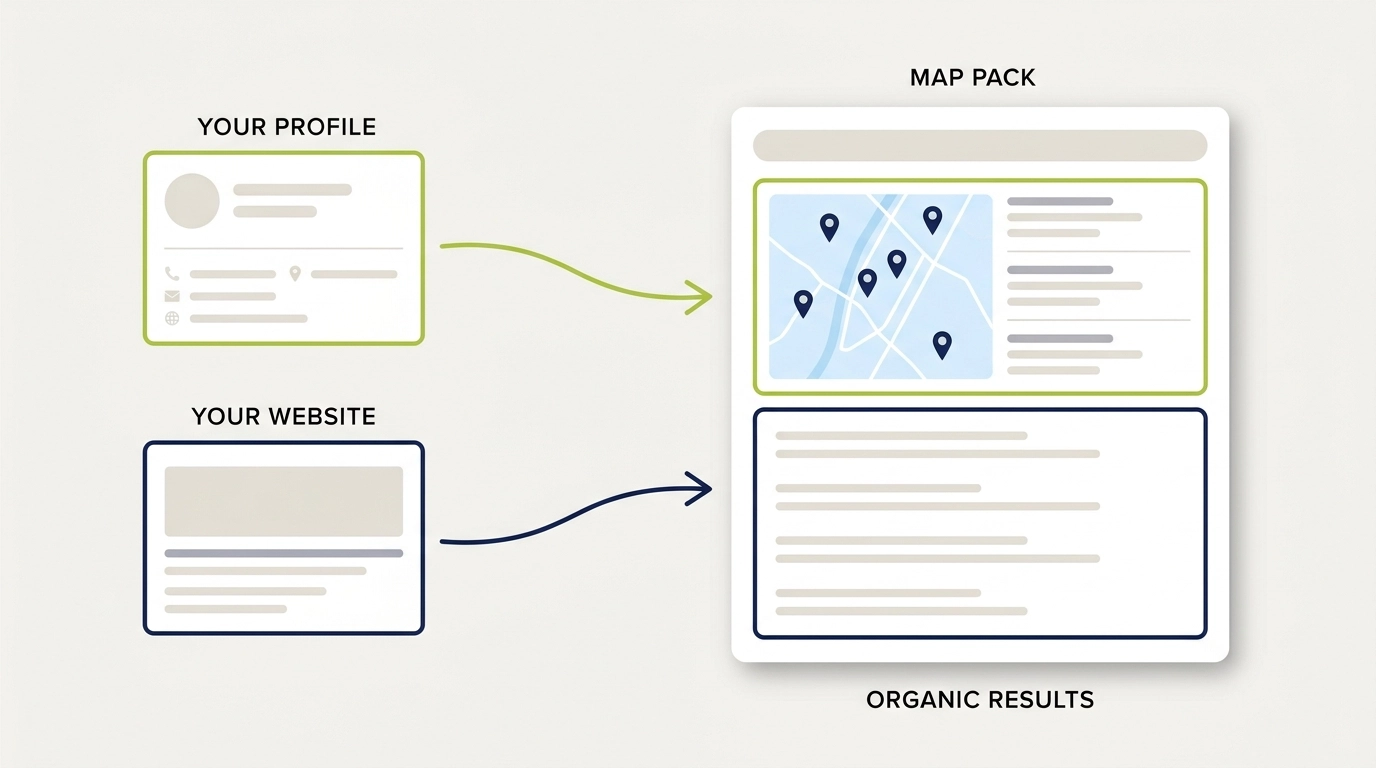
A local results page shows two things, and they rank on different signals.
The map pack is the box with the map and three business listings. It ranks mostly on your Google Business Profile, your reviews, and how close you are to the searcher.
The local organic results are the normal blue links below the map. They rank mostly on your website. Your pages, your content, and the links pointing at them.
This split matters because the same fix does not help both. Choosing a better business category can move you in the map pack and do almost nothing for the links below it. Writing a strong service page can lift your organic position and leave your map ranking exactly where it was.
So treat them as two jobs. The profile wins the map pack. The website wins the organic results.
The map pack, in short
Google says map results come down to three things. Relevance, which is how well your profile matches the search. Distance, which is how close you are. Prominence, which is how well known your business is.
You cannot change distance. You can change the other two, and most of that work happens inside your profile.
We cover this surface in full detail elsewhere, including all the signals in order and how to work out which one is holding you back. Start with Google Maps ranking factors if the map pack is where you are losing.
Two things do most of the work there. Your primary category, which decides which searches you belong to at all. And optimizing your Google Business Profile so every field is filled in and current.
The rest of this guide covers the half that gets less attention.
Local organic, the half most guides skip
The blue links below the map are won on your website. This is where most local businesses have nothing.
Location pages that are worth having
A location page is a page on your site about one place you serve. A plumber covering four towns might have four.
These work when each page says something true and specific about that place. Real jobs you have done there. Areas you cover and areas you do not. Travel time. Local prices if they differ. Photos from actual work in that town.
They stop working when you build one page per town and swap the town name. Search engines have seen that pattern for years. A set of near identical pages tends to leave you ranking for none of them, because each one is too thin to win and they compete with each other.
A useful test before you build one. Could you write four hundred words about serving this place that would be wrong if you pasted them under a different town name? If not, the page should not exist yet.
Local content beyond the service pages
Most local businesses never write anything that proves they work where they say they work.
Case studies naming the area. Answers to questions only local customers ask. Notes on local rules, permits, weather, or building types that affect your work. A roofer in a town full of Victorian terraces has things to say that a national roofing guide cannot.
This content does two jobs. It gives your site real reason to rank for local searches. It also gives AI search tools something specific to quote, which generic service copy never does.
On-site signals
A few small things on the site itself help search engines connect your pages to a place.
Add LocalBusiness schema with your name, address, phone, and hours. Put your address in the page markup, not just inside an image. Keep the format of that address the same everywhere it appears. Link your location pages to each other and to your main service pages, so the structure is clear.
None of this is hard. Most sites simply never did it.
When you have more than one location
Multi-location work is where local SEO gets messy, and it is barely covered anywhere.
Three rules handle most of it.
One profile per real location. A separate profile needs a separate staffed address. Not a mailbox, not a co-working desk you rent by the hour.
One page per location, with its own URL. Something like /locations/leeds/ rather than a single page listing every branch. Each page needs its own title, its own content, and its own reason to exist.
Decide which location owns which search. Two branches twenty minutes apart will fight over the same city search if you let them. Give each page one main area and keep the other pages off that term.
Where this breaks down is usually growth. A business opens a fifth branch, copies the fourth branch's page, changes the town name, and quietly weakens all five.
Reviews, listings, and the signals built off your site
Two off-site signals carry most of the weight in local search.
Reviews feed the prominence side of map ranking and they decide whether anyone clicks you at all. Rating matters, but so does how many reviews have actual written text, and whether new ones keep arriving. A business with forty reviews from this year usually beats one with sixty from three years ago. The practical side of asking for them without breaking platform rules is covered in how to get more Google reviews.
Listings and citations are mentions of your business name, address, and phone on other sites. Directories, industry bodies, map platforms. They matter less than they did ten years ago, but they still help confirm that your business details are consistent and real.
Get the major ones right and ignore the long tail of weak directories. A working list is in free business listing sites for local SEO.
The thing to watch with listings is consistency, not volume. One old address sitting on a directory you forgot about can undercut the whole set.
Local link building
Links still matter for the organic half of local search. Local links matter more than general ones.
The ones worth getting are the ones that exist for a real reason. Sponsoring a junior football team. A chamber of commerce page. A supplier listing you as a local installer. Local news covering something you actually did. A trade body directory for your region.
What does not work is buying links from a list, or chasing high authority sites with no local connection. A link from a well known national blog does less for a local plumber than a link from the town council's trader directory.
Keep this slow and real. A handful of genuine local links beats fifty bought ones, and it does not put the rest of your site at risk.
Targeting a neighbourhood rather than a city
City level targeting is the normal starting point. Some businesses need to go smaller.
In dense cities, people search by neighbourhood, not by city. Someone in Brooklyn does not search "restaurant New York". Competing at neighbourhood level needs tighter content and a different approach to location pages, which we cover in hyperlocal SEO for neighbourhood searches.
Most businesses do not need this. If your city has one main commercial area, city level is enough.
How to measure local SEO without fooling yourself
Do not check your rankings by searching from your office. The result you see is shaped by your location, your device, and your history. An incognito window does not fix it. You are one data point standing in one spot.
Use a grid rank tracker instead. It checks your position from many points around your business and shows you a map. Watch two numbers. Your average position across the grid, and how many of those points put you in the top three.
For the organic half, use Google Search Console. Filter for queries with place names in them. That shows you which local searches already bring you impressions, including ones you never targeted.
Track leads, not rankings. A profile call button tap is not a booked job. Position three for a term nobody searches is not progress. At SEOviser we ask clients for their actual booking numbers alongside the ranking data, because the two often tell different stories, and the booking number is the one that matters.
How long it takes and what it costs
Local SEO is faster than national SEO and slower than ads.
Profile changes can show within days or a couple of weeks. Category changes sometimes move things quickly. Reviews build over months, because you can only ask people as they come. Website work on location pages and content usually takes three to six months to show clearly.
Cost depends on how many locations you have and how much of the work is already done. A single location business with a decent website and no profile work needs far less than a five branch business starting from nothing. Be wary of any fixed price quoted before someone has looked at your profile, your site, and your competitors.
One thing worth knowing. Most of the highest value work here is cheap or free. Fixing your category, filling in your profile, asking customers for reviews, correcting your address across listings. None of that needs a budget. It needs someone to actually do it.
What to fix first
Work in this order. Each step makes the next one worth doing.
First, your Google Business Profile. Verify it. Pick the most specific primary category that matches your main service. Fill in every field. Check the map pin is on your actual door.
Second, your reviews. Build a habit of asking every customer. Reply to all of them. This is slow, so start it early and let it run while you do everything else.
Third, your listing consistency. Fix your name, address, and phone everywhere they appear. Start with the major platforms and stop before the junk directories.
Fourth, your website. Location pages with real local detail. LocalBusiness schema. Internal links between your location and service pages.
Fifth, local links. Only once the rest is working. Links into a weak foundation do very little.
Most businesses do step four first, because it feels like the real work. Then they wonder why the map pack never moved. The profile comes first.
If you would rather have someone run this as a plan rather than a checklist, that is the kind of work we do as an SEO agency that works across local and national search.
Frequently asked questions
How long does local SEO take to work?
Profile changes can show in days. Review and listing work takes a few months, since reviews only arrive as fast as customers do. Website work on location pages usually takes three to six months before you can judge it. Anyone promising top map rankings in a few weeks is guessing.
How much does local SEO cost for a small business?
It depends on how many locations you have and how much is already in place. The highest-value work, which is your profile, your categories, your reviews, and your address consistency, costs almost nothing except time. Paid help is usually worth it for website work, multi-location setups, and competitive markets.
What is the difference between local SEO and regular SEO?
Regular SEO competes with every site covering your topic. Local SEO competes only with businesses close enough to serve the same customer. Local also has a second results surface, the map pack, which ranks on your business profile rather than your website.
Can I rank locally without a physical address?
Yes. Service area businesses can hide their address and still appear in local results. The trade-off is that showing a real address helps, so keep your service area honest and make sure your verified location and map pin are accurate.
Can I do local SEO myself?
The profile work, yes, and most owners should. Verifying, choosing categories, filling in fields, asking for reviews, and fixing listings need no specialist. Website work, multi-location structure, and competitive markets are where outside help starts paying for itself.
Does local SEO work without a website?
Partly. A profile can appear in the map pack with no website at all. You give up the organic results entirely, which is usually half the available visibility, and you have nowhere to send people who want more detail before they call.
Faisal Mustafa is an Online Market Specialist. He has been providing result oriented quality SEO services to clients worldwide successfully since 2008. He has hundreds of reviews and feedbacks on marketing forums. He is the admin of SEO viser team and a successful online marketer.
OUR SERVICES





Request a free quote
We offer professional SEO services that help websites increase their organic search score drastically in order to compete for the highest rankings even when it comes to highly competitive keywords.
More from our blog
See all posts